
One of the most important measures of food quality is how animals and humans respond to consuming it ,also their health and reproductive success. Thus, the total advantage of high-quality goes beyond that indicated by digestible nutrient content and is compounded by a potential for being consumed at higher levels, a faster rate of digestibility, and perhaps a more efficient conversion of digested energy to produce energy.
How do you measure quality while the crop is growing without sending in samples for an expensive and hard-to-interpret lab test? One very simple and inexpensive method being used by a growing number of farmers is a refractometer, an optical instrument that measures percent sugars and dissolved minerals in the sap of a plant, which is correlated with the plant’s food-producing efficiency (photosynthesis) and with ultimate food quality. Refractometers are routinely used in the food industry, by canneries, wineries, and breweries for example, to measure the quality of the fruits and vegetables they buy from farmers or of the foods and drinks they manufacture.

Using a refractometer to check the quality of your crops is easy. Simply squeeze a few drops of juice from the stems or leaves of the plants onto the glass prism of the refractometer, close the “lid,” and look through the eyepiece. The sugar and mineral content is read on a numbered scale in units called Brix . By comparing with standard levels (see table) or past readings that you have made, you can see how your crops measure up that day.
Not all “high protein” feeds are truly nutritious for your animals. The best indicator to go by is the refractometer reading. A feed with a high protein figure but a low sugar reading will not be of high quality for your animals. It would be better to have a lower protein figure and high sugar.
This device measures dissolved solids in plant sap to provide an indication of your growing skills. It is essentially a measure of your chlorophyll management skills because high brix readings are intimately related to chlorophyll density and associated nutrient density.
The most important use of a refractometer is measuring your susceptibility to insect attack. The higher the brix levels, the less likely insect pressure is. If you have insect pressure in one area and not in another, the affected area will always have a lower brix reading. I have never seen an exception to this rule, and I challenge you to find an exception.
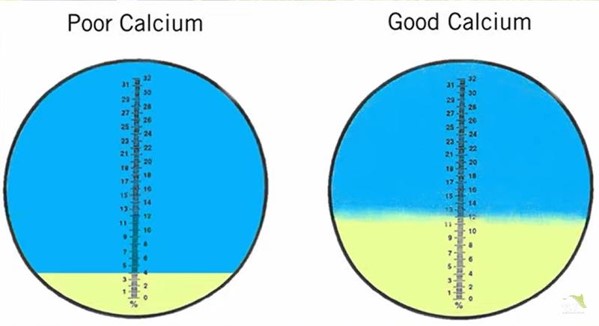
Example of a well defined reading with a clear distinction between the blue and white.
This is a clear indication of a calcium deficiency in the plant/crops/vegetables/fruit.
Acquiring a refractometer will be one of the best investments you can ever make.

When your mean reading is in the excellent range insect pressure disappears
High brick plants are nutrient dense plants that can only digested by animals and humans, bacteria, fungi and insect lack the enzymes to digest it.